House notes
Picking a bar height table base that holds a tall top steady
A guest sets an elbow on a bar table and the whole top dips toward them. Drinks shiver, someone grabs a glass, and for the rest of the night the party leans carefully. That is the first impression of the room, and it came from the base.
Tall tables rock more than low ones. The top sits farther from the floor, guests lean on it standing or perched on stools, and a small play at the foot becomes a large one at the edge. So at the bar, the base is the part of the table we spend the most time on with owners.

Open diagram at full size (new tab) ↗
Read the diagram in text
Three numbered cards: add the top's thickness to the 41-inch listed base height and aim for 40 to 42 inches finished; keep a round foot no smaller than two thirds the width of the top; choose adjustable glides, self-leveling glides or a bolt-down base. A note says a tall table shows every wobble.
- BAR FLOOR NOTES
- 1
- Height on paper: Listed base 41 inches plus the top Finished bar height 40 to 42 inches
- 2
- Spread for the top: Round foot: no less than 2/3 the top X prong sized to the party
- 3
- Meet the floor: Adjustable or self-leveling glides Bolt-down base where it stays put
- A tall table shows every wobble: pick the base by its top and by the floor under it.
- Add the top to the base, size the spread to the top, then decide how the base meets the floor.
Do the height sum on paper
Bar height, finished, lands at about 40 to 42 inches from floor to tabletop, and a matching stool seat rides between 29 and 31 inches off the floor. Our bar-height table bases list a height of 41 inches. The top goes on above that, and its thickness is the part buyers forget.
Run the numbers before you choose the top. A 1-inch Werzalit top on a 41-inch base comes to 42 inches on paper, the top of the range. A reversible laminate top lists 1 1/8 inches, which puts the sum just over 42. A solid wood top at 1 1/2 inches brings it to 42 1/2. None of those is a reason to reject the top, but each one is a reason to check the assembled height with us before the order goes in, because the stools you have chosen were picked for a particular gap.
The usual mistake goes like this. An owner orders a base listed at bar height, a thick top from a separate page, and stools at 31 inches, then finds the guests' knees fine but their forearms high on the table. Ten to twelve inches between seat and top is the dining figure; keep the bar pairing close to the same feel by doing the sum once, with the actual stools in it.
Size the spread to the top
The rule of thumb we carry around is short. Take the diameter of the top, divide by three and double it: the foot of a round base should be no smaller than that. Tall tables deserve the rule more than any other.
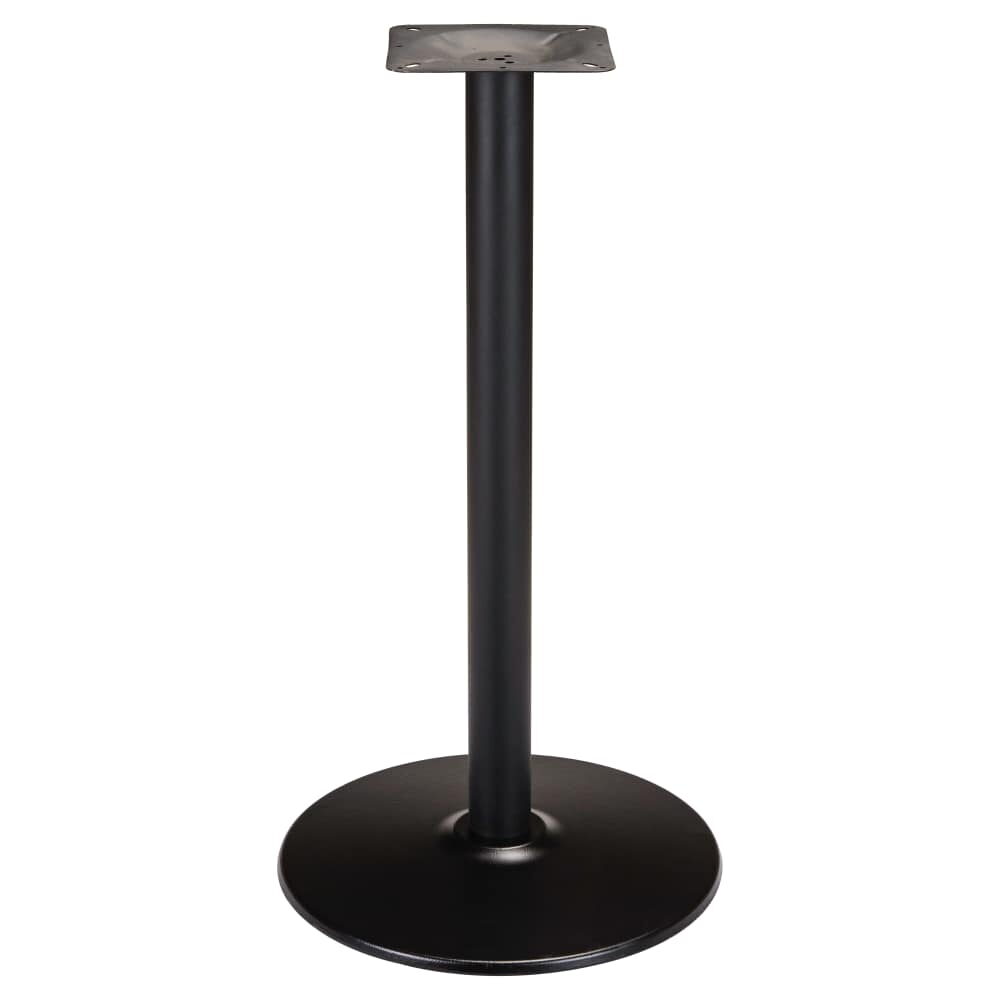
Say you want 30-inch round tops for pairs at the bar rail. Two thirds of 30 is 20, so a 17-inch foot is too small and the 22-inch size is the one to choose. The round cast iron bar base is listed in exactly those 17, 22 and 30 inch diameters at 41 inches high. Move up to a 42-inch round for four and two thirds is 28, which points you to the 30-inch foot.
Square and rectangular tops read the same way off an X prong. The cast iron X prong bar base comes in four spreads at 41 inches: squares of 22, 30 and 33 inches, plus a 22 by 30 rectangle. A 30-inch square seats two, so the 22-inch square foot suits it. A 36-inch square seats four, and a party of four leaning in at once wants one of the two larger squares under it. If the bar runs on a long rectangle, the rectangular foot lines up with the long side.
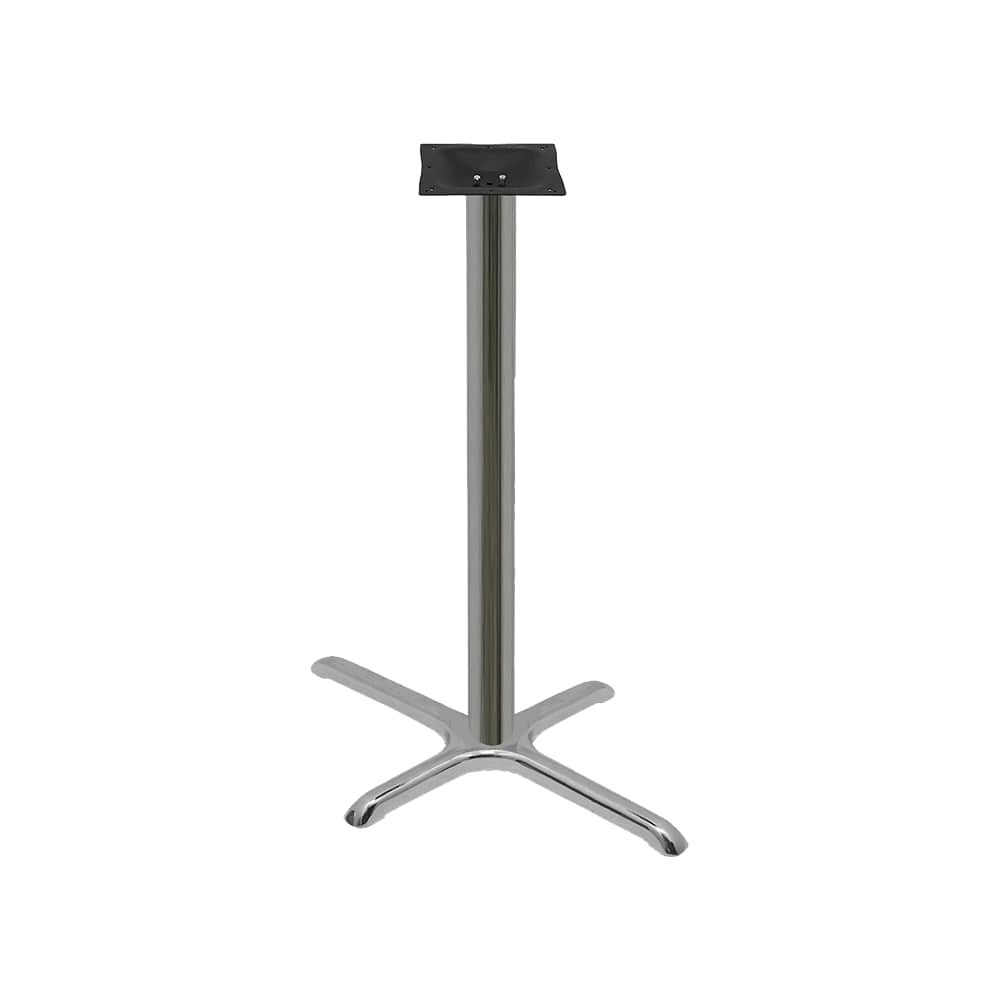
For a brighter bar, the chrome X prong bar base carries the same 41-inch height in the 22-inch and 30-inch squares and the rectangle, without the largest size. The full run of X prong bases shows the other finishes.
How the base meets the floor
A base can be the right size and still rock, because bar floors are rarely flat. Tile seams, drains near the service well and old boards near the windows all move a foot by a fraction of an inch.
The round and X prong cast iron bar bases both give you a choice at the foot. Adjustable glides come standard; self-leveling glides are the step up. Adjustable glides are set once by staff and checked when tables move. Self-leveling glides take up small differences on their own, which helps in a room where tables are pulled together for a private event and pushed back the next day.
Where tables never move, fix them down. The cast iron bolt-down base is listed with a 41-inch bar height option as well as a 28-inch standard one. Along a window ledge or a fixed rail it ends the wobble for good, and it also keeps the line straight when the room is full. Check the floor before you plan it; a bolt-down base wants solid footing and someone on your side who is ready to anchor it.
Both cast iron bar bases also offer a footrest. At 41 inches, guests on stools spend the night with their feet looking for a place to rest, and a ring on the base gives them one without crowding the stool's own rail.
The base and the room around it
A bar floor is planned by the stool, not the table. Each stool claims two feet of rail at the least and two and a half at most, counted between seat centers; two stools on one side of a 30-inch square use that edge up at the generous end. Put the table count against that spacing before you order bases, and you will know how many tables the standing area really holds.
If a complete table is simpler, the bar-height tables arrive with top and base paired, and our guide to the bar table set covers sets that bring their stools along. For the stools themselves, the piece on club bar stools looks at seats and backs for a members' bar.
Before the bases go on the order
Put the bar in its own plan in venue plans and list each table as base, top and stool count together, with the top's thickness and the base spread in the notes. That one line answers the height sum and the spread rule at a glance when we review the order.
A base that proves faulty in its materials or its making is covered for a year, and the warranty page sets out how to claim. The broader range of table bases stays on hand if the dining room needs its own. When the bases arrive, set one under its top, sit a guest at it on the stool you chose, and lean on the far edge before you unpack the rest.