House notes
Choosing club bar stools for the wait before dinner and the hour after
The club bar does two jobs in one evening. Before dinner it is where members wait for their table, a drink in hand, half watching the door. After dinner it is where they come back to, and some stay until the lights go up. A stool that suits only one of those jobs is the wrong stool.
That second shift is why club bars lean toward upholstered seats, padded backs and, where the rail allows, arms. It is also why the stools should look as if they belong to the same house as the dining room chairs, because members walk between the two rooms all night.

Open diagram at full size (new tab) ↗
Read the diagram in text
Three cards compare stools by slot: a narrow armless upholstered stool in a 24-inch slot, a stool with arms in a 30-inch slot, and a swivel stool with arms. A side panel works a 20-foot bar: 240 inches of rail, ten stools at 24 inches or eight at 30.
- CLUB BAR NOTES
- Armless, upholstered: 19 inches wide fits a 24-inch slot
- 24 IN SLOT
- With arms: 23 3/4 inches wide wants 30 inches
- 30 IN SLOT
- Swivel with arms: Turns to the room without sliding
- 30 IN SLOT
- A 20-foot bar
- 240 inches of rail
- 10 stools at 24 inches
- 8 stools at 30 inches
- Count the slots before choosing the stool.
- The wider the stool, the wider its slot along the rail, and the fewer members the bar seats.
Upholstered seat, padded back
Begin with the seat height, because everything else hangs from it. A bar top stands about 40 to 42 inches from the floor, and the stools that suit it put the seat at about 29 to 31 inches. Every stool we name below lists its seat inside that band.
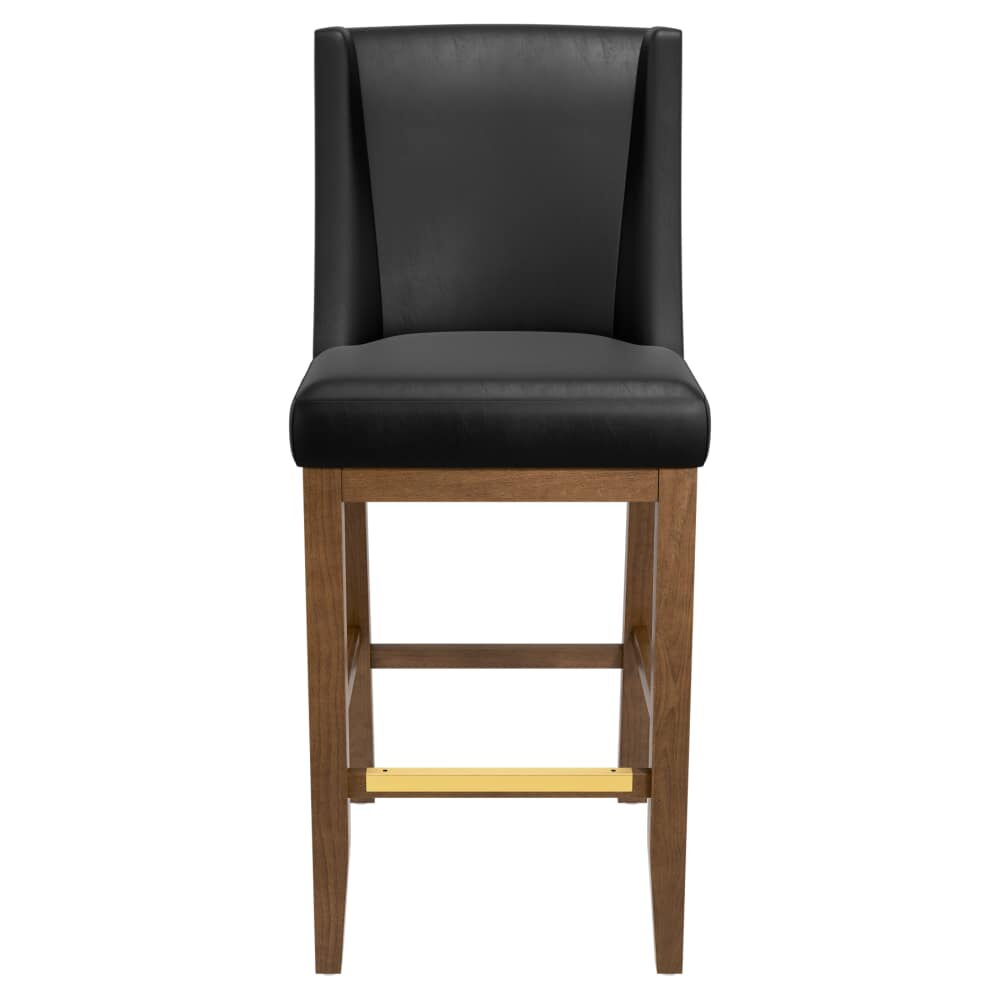
The upholstered bar stools are where most club bars shop. The Varden padded bar stool is a useful reference: a wood frame, a padded back, fabric or vinyl on the seat, a 30-inch seat height and 19 inches of width. That narrow frame matters more than it looks, as the arithmetic below shows.
Fabric or vinyl comes down to the room. A quiet members' bar off the dining room can carry fabric. A busy bar that serves the terrace and the after-match crowd is easier to keep in vinyl, which staff wipe down at the end of the night.
Arms, swivels and the width they cost
Arms give a member something to rest an elbow on during a long conversation, and they mark each seat as its own place at the rail. They also make the stool wider.
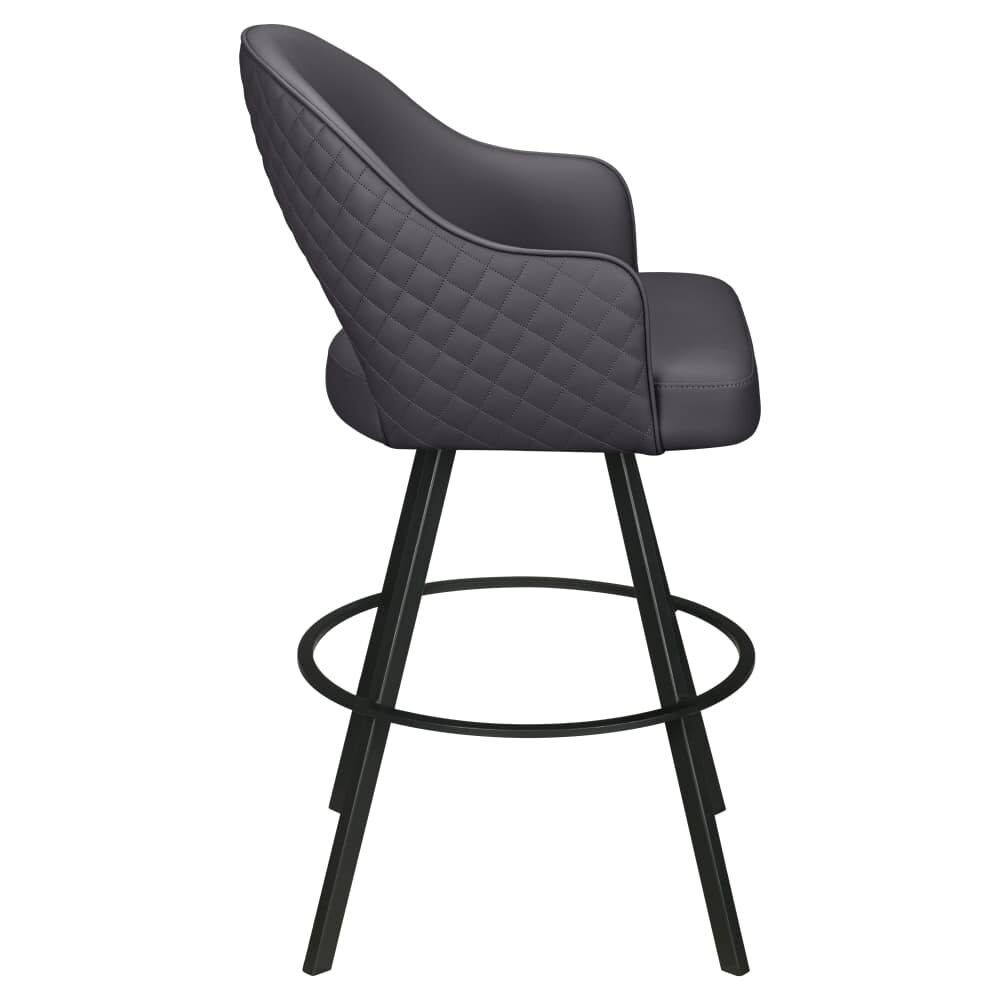
Take the metal bar stool with arms. Its frame finishes in black or dark walnut, the back is padded and covered in vinyl, and a member perches 29 3/4 inches above the floor. Across the arms it measures 23 3/4 inches. Compare that with the 19-inch padded stool above and the difference is almost five inches per seat.
Swivels change how the bar is used. A member on a swivel turns toward a friend at the next table and back to the bartender while the stool stays where it stands, and at closing the staff have fewer stools to push back into line. The bucket swivel bar stool with arms on a circular frame is 21 1/2 inches across; its seat matches the armed metal stool at 29 3/4. The full range of swivel bar stools and bucket bar stools sit side by side for comparison.
One thing to weigh: our warranty periods differ by type. Non-swivel metal stools carry seven years; swivel metal stools carry one. The warranty page sets out every period.
How many stools a club bar really seats
Each stool needs its own stretch of rail, between 24 and 30 inches when you measure center to center. The width of the stool decides which end of that range you need.
Here is the worked example. Take a bar with 20 feet of usable rail, 240 inches. At the tight end, 24 inches a stool, you can line up ten. At the generous end, 30 inches, you get eight. The 19-inch padded stool sits easily in a 24-inch slot with five inches to spare between frames. The 23 3/4 inch stool with arms leaves a quarter of an inch in that same slot, which means touching arms all night, so it belongs at 30 inches, and the bar seats eight.
Two stools fewer is a real decision for a club bar on a busy weekend, when every seat at the rail is a member who did not have to stand while waiting for a table. Some rooms split the difference: armless stools along the long run where members stand behind and talk, stools with arms at the two ends where there is space to give.
The mistake here is choosing the stool from a photograph and counting the stools from the old bar. The old stools were narrower, the new ones are not, and the delivery arrives with two more stools than the rail will hold. Measure the rail, pick the slot, then pick the stool.
Stools that belong to the dining room
Members carry their eye from the dining room to the bar. When the stools share a frame family and a finish with the dining chairs, the two rooms read as one house.
The easiest way to do that is to choose a chair and a stool from one family. The Varden padded bar stool has a dining chair partner with an 18-inch seat, in the same wood finishes. The upholstered bar stool in the bucket family has a dining chair twin in the same shape; the stool seat rides at 29 1/2 inches and the chair seat at 19 1/2, both in black, dark walnut or walnut metal finishes. The other bucket dining chairs sit with the chairs if the dining room wants more of that shape. Order both from one swatch. When you come back for more stools in a few years, the upholstery list may have moved on, so request a current swatch and check it against the old seats first.
Our guide to club dining chairs works through the dining room side, and the arm bar stools collect every stool with arms in one place if the bar leans that way. For the classic frames, see ladder-back bar stools.
A bar measured before it is ordered
Start a plan for the bar in venue plans, separate from the dining room. Write the rail length in the notes, then the slot you chose, then the stool count that follows from the two. Add the matching dining chairs to the dining room's own plan with the same finish noted.
Then take a tape to the bar on a quiet afternoon, with one of the current stools beside the marks for scale. Mark the slot every 24 or 30 inches along the rail with painter's tape, and stand back. If the marks look crowded, they will look more crowded with members in them.