House notes
What round cafeteria tables cost in floor, and what they give back
Rows of long tables make a dining hall look like a hall. Rounds make it look like a room full of tables. Everyone at a round faces the middle, nobody sits at the far end of anything, and a group of six talks across the table instead of down it.
Round cafeteria tables give that back, and they charge for it in floor. A circle never fills the square of floor it stands in, and the gaps between rounds seat no one. Knowing what rounds cost and what they return lets you decide where they belong in your hall, and how many of them to buy.

Open diagram at full size (new tab) ↗
Read the diagram in text
Three cards show round tops: a 42-inch round seats four to six on 28 inches of base spread, a 48-inch round seats six on 32 inches, and a 60-inch round seats eight on 40 inches. A side panel gives the two thirds rule.
- ROUND TABLE NOTES
- 42-inch round: Four to six guests, 28 in of spread.
- 132 in edge
- 48-inch round: Six guests, 32 in of spread.
- 151 in edge
- 60-inch round: Eight guests, 40 in of spread.
- 188 in edge
- THE TWO THIRDS RULE
- 36 in top: 24 in base
- 42 in top: 28 in base
- 48 in top: 32 in base
- Size for the open top.
- Divide the edge by the guests, then give the base two thirds of the top's diameter.
How many guests a round really seats
Start with the edge. Two feet of rim per diner is the comfortable allowance, and a hall that squeezes should stop at a foot and a half. The edge of a round is its circumference, a little over three times its diameter.
So work it through. A 42-inch round has about 132 inches of edge: four guests get 33 inches each, five get about 26, and six get 22. A 48-inch round has about 151 inches, which gives six guests about 25 inches apiece. A 60-inch round has about 188 inches, enough for eight at roughly 23 and a half. That squares with the usual planning guide. Four to six guests belong at a round between 42 and 48 inches across, a party of eight wants the 60, and four can squeeze around a 36-inch round when floor is scarce.
Here is the mistake to watch for. A 48-inch round with eight chairs looks as if it fits on the floor plan. Divide the edge and each guest gets under 19 inches, a hair above the tightest figure, with trays touching and elbows locked. Seat six there, or move the group of eight to a 60.
What rounds cost in floor
A round top covers about 78.5 percent of the square of floor it would sit in, since a circle's area is pi over four of its bounding square. The corners are left over. In a room of rows, a long table fills its rectangle edge to edge, and chairs back up to chairs along a straight aisle.
Put it in a hall. Say one section has 2,000 square feet of dining floor, and you plan at 13 square feet a seat, inside the counter-service range of 11 to 14. That section holds about 153 seats. In 60-inch rounds of eight, that is 19 tables and 152 seats. In 48-inch rounds of six, it is 25 tables and 150 seats, six more tables for two fewer guests, with more aisles between them. Check every count against the building's occupancy limit, which your architect or designer confirms with the local codes.
There is a second, quieter cost. Rounds cannot be pushed together. Two long tables join into one for a team lunch, but two rounds stay two rounds, so a party of twelve needs neighboring tables or a row somewhere else in the hall. Keep a short run of long tables for those days.
The rule of thumb we give: use rounds where the hall wants conversation, and long tables where it wants speed. One workable layout sets rows near the serving line and rounds by the windows, the mix our guide to cafeteria seating walks through.
A base for every top
A round lives or dies by its base. Measure the base across its foot: that spread has to cover two thirds or more of what the top measures, or the table rocks when someone leans on its edge.
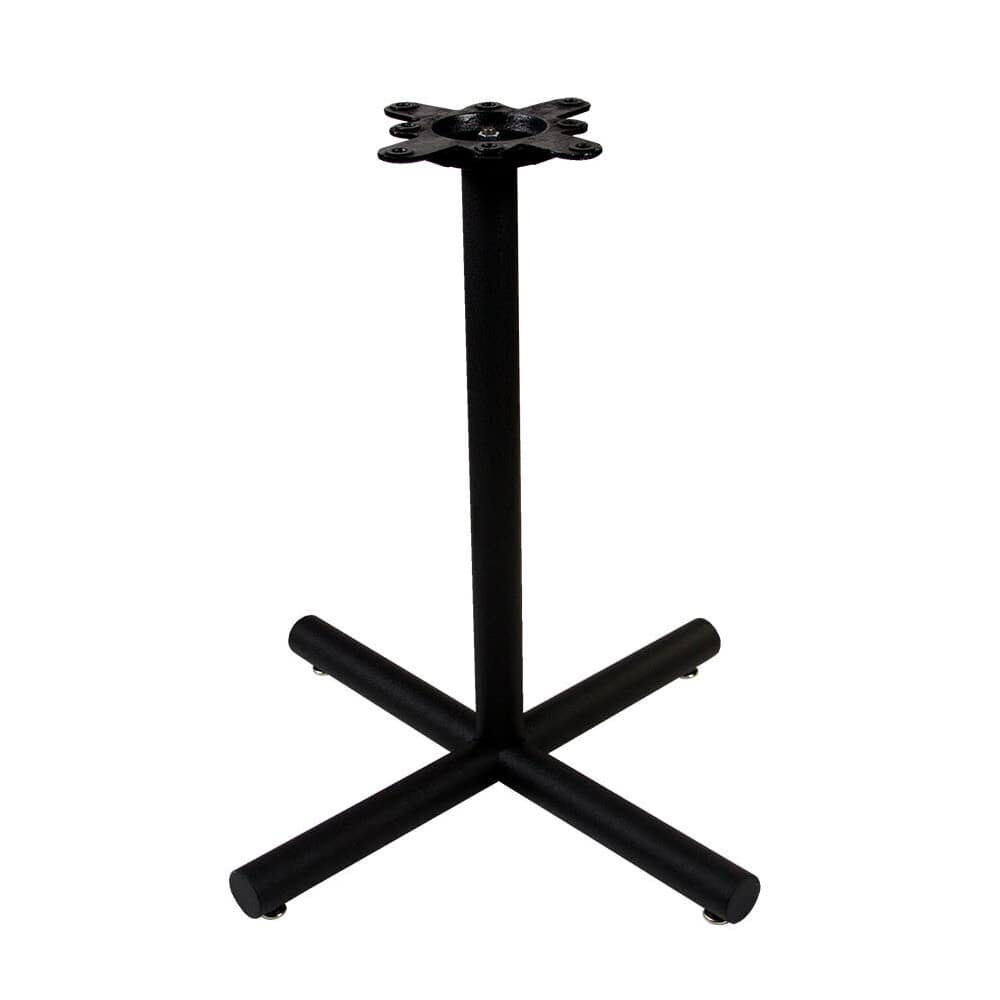
That rule sorts the catalog quickly. Under a 36-inch round, look for 24 inches of foot; under a 42, look for 28. A round metal table base in black cast iron, 28 inches high, is sold with a foot of 17, 22 or 30 inches across, so its 30-inch size carries either top. For a brighter hall, a chrome round table base offers the same three sizes at the same height. The full range of round table bases sits on one page.
A 48-inch top asks for 32 inches of spread, beyond either round base. Choose a cast iron X-prong table base, which comes in 22, 26, 32 and 36 inch squares; the 32 or the 36 meets the rule. Browse more spreads among the X-prong table bases. For a 60-inch round, the rule asks for 40 inches. Book a call through talk to a specialist and confirm the base for that size before you order a row of them.
Tops that change size
A dining hall that seats four at lunch and eight at an evening event can buy one top for both. Our laminate tabletop with a PVC edge is offered as fixed rounds between 24 and 60 inches, and as drop-leaf squares that turn into circles. The smallest, 30 inches square, becomes a 42-inch circle; the 36 becomes a 51; the 42 becomes a full 60. The square sits flush against a wall or a neighbor for daily service and opens out for the banquet.
Set the base for the open size, not the closed one. A 42-inch square that opens to 60 inches needs the base you would choose for a 60-inch round. Laminate wipes clean between sittings, and our laminate tops come in stone looks, wood grains and solid colors, and the wider range of table tops adds wood, resin and stone.
Rounds that fold away
Some halls clear their rounds for dances and graduations. Folding tables are covered in our guide to folding cafeteria tables, and the sister guide to cafeteria tables shows how rounds fit with long tables and fours. Browse complete tables, with their bases already chosen, under dining tables.
Counting tops and bases on one sheet
Make the round section its own plan in Venue plans. Put tops and bases on separate lines, one line per size and finish, and in the notes write which base goes under which top. For 19 tables of eight, that is 19 tops, 19 bases and 152 chairs, and the sheet you download shows all three counts side by side.
Before the order goes in, set one round on site with its chairs pulled out and walk a full tray around it. If you have to step sideways between it and its neighbor, take one table out of the plan and give the rest the space.